The PMBOK® Framework
PMBOK is not a magic recipe, but it gives you a shared map: common words, common phases, and common checks that prevent the most expensive surprises.
PMBOK stands for Project Management Body of Knowledge. It’s a standard published by the Project Management Institute (PMI). People often meet it through certifications like CAPM or PMP, but you don’t need a certificate to benefit from the ideas.
WHAT PMBOK IS (AND WHAT IT ISN’T)
PMBOK is:
- A reference framework: it describes how project management is commonly done across many industries.
- A shared vocabulary: useful when a team needs to align quickly.
- A set of process groups and knowledge areas that cover most project situations.
PMBOK is not:
- A guarantee that your project will succeed.
- A strict step-by-step instruction for every project (real projects don’t behave that politely).
- A replacement for domain expertise (you still need people who understand the product).
SO… WHAT COUNTS AS A “PROJECT”?
In PMBOK language, a project is temporary work that creates a unique result.
That definition is simple, but it’s surprisingly helpful. A project is usually “project-like” when:
- You’re doing something new or meaningfully different.
- You can’t accurately predict cost/time/risks from a previous identical example.
- You expect uncertainty, learning, and changes along the way.
Example:
- A company that has never built anything decides to build its first building: that’s a project.
- Once that company builds identical buildings every month: that becomes an operation (repeatable work).
- When the company decides to build a bridge (new constraints, new unknowns): project again.
THE “CONSTRAINTS” EVERY PROJECT JUGGLES
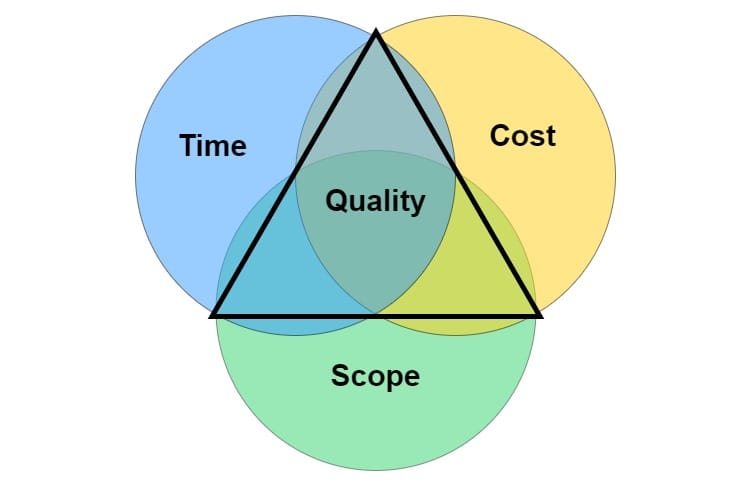
PMBOK often talks about constraints—things that push and pull against each other. A useful way to remember it is: if you change one constraint, the others usually move too.
Common constraints include:
- Time (deadline, launch date)
- Cost (budget)
- Scope (what is included and what is not)
- Quality (how “good” the result must be)
- Risk (what could go wrong, and how likely)
- Stakeholder satisfaction (how people feel about the outcome)
This is why “just do it faster” rarely means only “faster”. It often means faster and more expensive, or faster and lower quality, or faster and higher risk. Sometimes that tradeoff is worth it. Sometimes it’s quietly fatal.
PMBOK’S BIG STRUCTURE: PROCESS GROUPS (THE LIFE OF A PROJECT)
A classic PMBOK way to describe a project is through five “process groups”:
- Initiating — decide what we’re doing and why; confirm we should start.
- Planning — decide how we’ll do it; create the plan we’ll actually use.
- Executing — do the work; build the thing.
- Monitoring & Controlling — keep the project on track while it’s happening.
- Closing — finish properly; hand over; learn; wrap up.
Important detail: Monitoring & Controlling is not a phase that happens once. It happens throughout the project—like checking your route while driving, not only after you arrive.
1) Initiating (starting with clarity)
Initiating is where you:
- Define the goal in plain language
- Identify the key stakeholders (decision makers, users, people impacted)
- Appoint a project manager (or at least someone accountable)
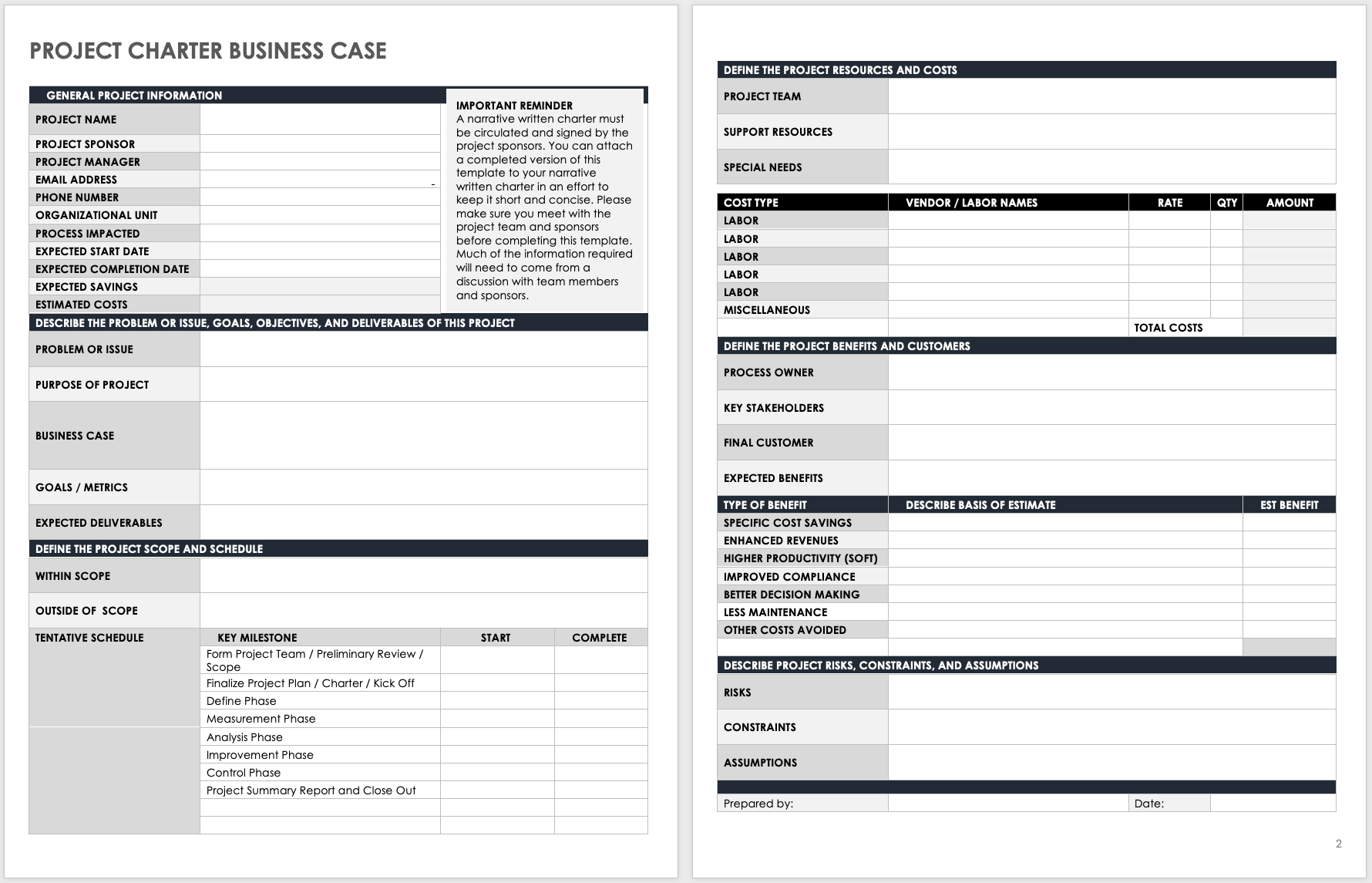
- Create a basic “project charter” (a one-page “why/what/who/when”)
If you skip this, the project might still move… but it tends to move in circles.
See a Project Charter example in the end of the article ⬇️
2) Planning (where most projects are won or lost)
Planning is not about writing a beautiful document. It’s about removing uncertainty early, while it’s still cheap.
Planning usually includes:
- Scope and requirements (what’s in / out)
- Work breakdown (tasks broken down to workable sizes)
- Timeline and dependencies (what must happen before what)
- Budget estimate
- Risk plan
- Communication plan (who needs updates, how often, and in what format)
A practical tip: planning is most valuable when it results in a plan that people will actually look at. If it’s 70 pages and nobody reads it, it’s basically a fancy comfort blanket.
3) Executing (doing the work, managing reality)
Execution is when the plan meets reality. The core job is:
- Coordinate people and tasks
- Keep quality acceptable
- Communicate changes early (not at the last minute)
This is also where teams often discover that a “perfect” plan doesn’t survive contact with new information. That’s normal. The trick is adapting without losing control.
4) Monitoring & controlling (steering, not blaming)
This is where you:
- Track progress against the plan
- Identify deviations early (schedule slip, budget creep, scope growth)
- Make decisions and adjustments
In human terms: it’s the difference between “We’ll be fine” and “We’ve been behind for three weeks, but no one wanted to say it.”
Useful monitoring questions:
- Are we still delivering the original goal—or did it drift?
- Are risks changing? Are new risks appearing?
- Are stakeholders still aligned, or are expectations quietly diverging?
5) Closing (ending like a professional)
Closing is not just “we shipped”. It includes:
- Formal acceptance (someone actually says: yes, this is done)
- Handover (docs, training, access, ownership)
- Contract/finance closure (if applicable)
- Lessons learned (what to repeat, what to avoid next time)
The “lessons learned” part gets skipped a lot. But it’s one of the highest-leverage habits a team can build.
KNOWLEDGE AREAS (THE “WHAT” YOU MANAGE)
PMBOK also groups knowledge into areas like:
- Integration
- Scope
- Schedule/Time
- Cost
- Quality
- Resources (people)
- Communications
- Risk
- Procurement
- Stakeholders
You don’t need to memorize the list. What matters is the mindset: projects fail for predictable reasons—misaligned scope, unrealistic time, unmanaged risks, poor communication. PMBOK is basically a reminder to manage those things on purpose.
A SIMPLE WAY TO USE PMBOK WITHOUT GETTING BUREAUCRATIC
If you’re working solo or in a small team, you can take the spirit without the paperwork. Here’s a lightweight PMBOK-inspired checklist:
- Initiate: Write a 10-line charter (goal, success criteria, owner, deadline).
- Plan: List tasks + dependencies; define “done”; identify top 5 risks.
- Execute: Work in short cycles; keep stakeholders updated.
- Control: Every week, check scope/time/cost/risk and adjust.
- Close: Get explicit acceptance; write 5 lessons learned.
That’s it. Nothing fancy. Just surprisingly effective when done consistently.
A Project Charter template example - this will help you to initiate your project right way: